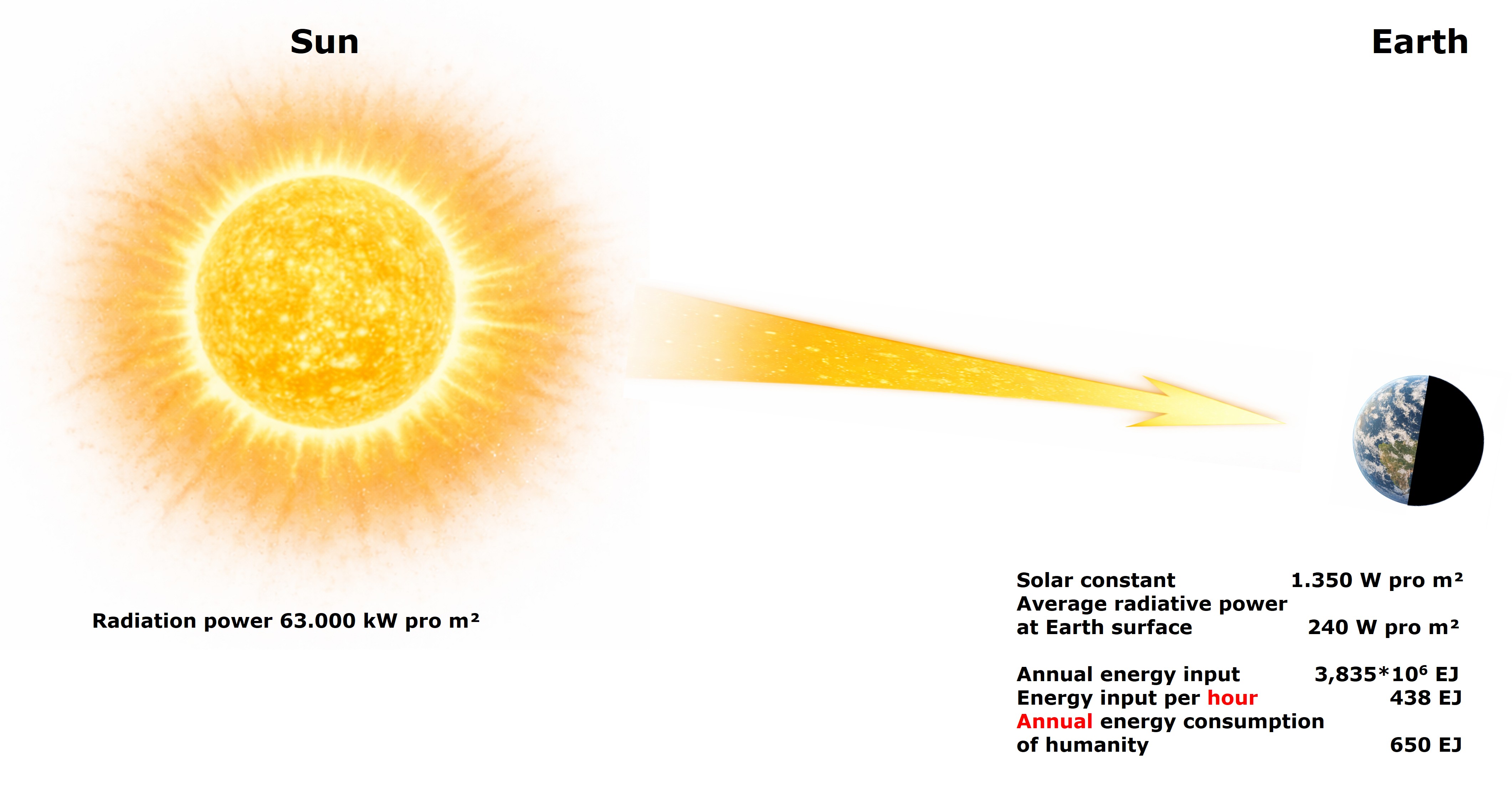
Energy flow from the Sun to Earth with impressive figures
(© Brugger 2026)
This continuously flowing amount of energy is enormous.
For comparison:
The total energy consumption of humanity, about 650 EJ per year, is extremely small in comparison (factor 5,900). The amount of solar energy arriving per hour corresponds to about 68% of global annual energy consumption.
Therefore, direct anthropogenic energy input plays practically no role compared to solar energy input. The decisive factor for the climate is not additional human energy, but the distribution of existing solar energy within the atmospheric system.
Only a very small part becomes wind
Only a small fraction of incoming solar energy is converted into kinetic energy of the atmosphere. Estimates suggest that only about
1–2% of solar energy
is converted into kinetic energy of air masses. Part of this energy drives vertical convection or is dissipated through waves and friction.
For large-scale horizontal wind systems, only about
0.5–1% of the original solar energy
However, this seemingly small amount of energy has a central importance: it drives large-scale air circulation that transports heat and moisture across the planet remains.
Wind as a central climate regulator
Wind is the mechanism that distributes the energy introduced by the sun. It transports heat from the tropics to higher latitudes and moisture from the oceans to the continents.
Thus, atmospheric circulation controls the global water cycle. Without these air movements, extreme temperature differences and massive precipitation imbalances would develop.
Wind is therefore an essential component of the natural climate equilibrium.
More on this on the pages Wind Energy and Global Water Cycle.
Using solar energy — preferably directly and efficiently
The sun is by far the most important energy source on Earth. It also provides the basis for technical energy generation. The decisive factor is not only that solar energy is used, but how it is used.
From a physical perspective, a simple rule applies:
The more direct the use, the higher the efficiency.
Every conversion involves losses and reduces the usable energy.
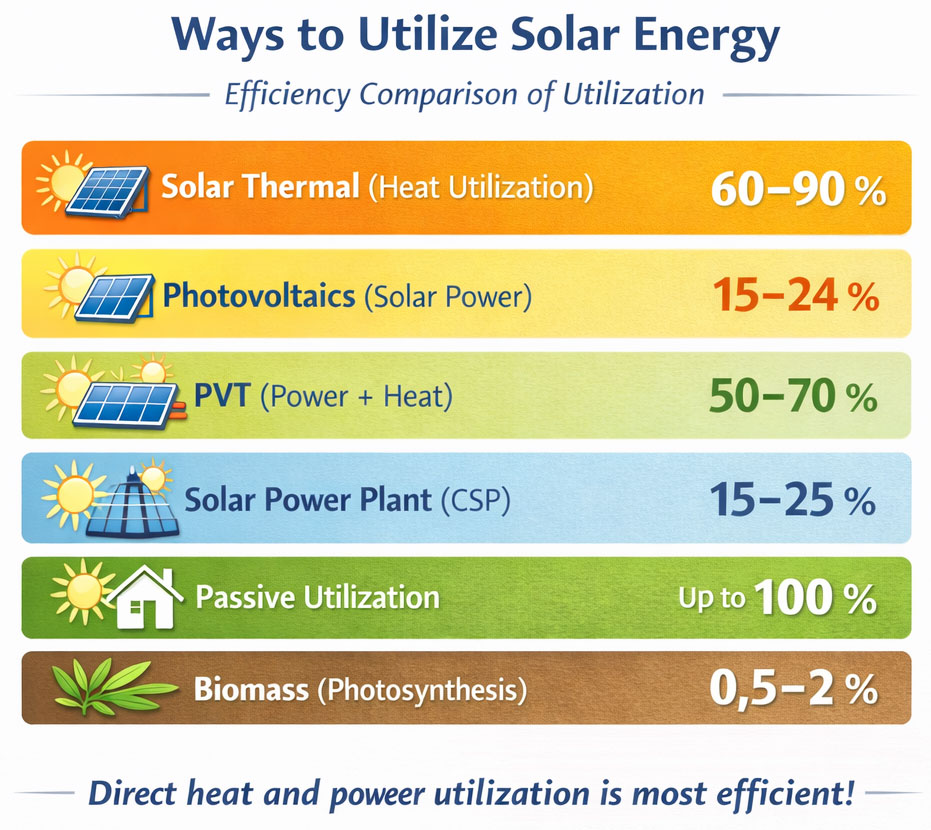
Direct use mainly refers to solar thermal energy, i.e. the direct conversion of solar radiation into heat. Depending on system and operating conditions, very high efficiencies can be achieved. It is particularly suitable for hot water, heating and industrial process heat.
Passive use also plays an important role: window areas, building orientation, thermal mass and architectural design can make solar heat directly usable without any technical conversion.
Optimal use of solar energy
(© Brugger 2026)
Solar thermal energy for direct heat use
Solar thermal systems use solar energy directly for heat generation. In contrast to photovoltaics, no conversion into electricity takes place. This results in several physical and energetic advantages and very high efficiencies — depending on the collector — of up to 90%.
- Flat plate collectors: approx. 50–70%
- Vacuum tube collectors: approx. 60–80%
- Low-temperature applications: up to approx. 90%
Solar thermal therefore clearly exceeds photovoltaics, where usually only 15–20% of radiation energy is converted into electricity.
👉 From a physical standpoint, solar thermal is the most efficient use of solar energy
Ideal for:
- Domestic hot water and heating
- District heating and local heating networks
- Industrial process heat
Existing roof and building areas can be used ideally for collector installation. Solar thermal has high power density, can be used locally and heat can be stored easily.
Photovoltaics (PV) – flexible, but significantly lower efficiency
Photovoltaics convert sunlight into electricity. However, efficiency is significantly lower than for direct heat use. A large portion of incoming energy is converted into heat or lost through additional system losses.
Therefore, photovoltaics are particularly advantageous where electrical energy is actually required. If the generated electricity is later used again for heat generation, this is usually energetically less favorable than direct solar thermal use.
Typical efficiencies:
- Standard modules: 18–22%
- High-performance modules: 22–24%
- Complete system (incl. losses): 12–18%
The greatest benefit and best use of solar energy is a decentralized combination of solar thermal and PV (with storage) installed on roofs and buildings.
Ground-mounted photovoltaics
Ground-mounted PV systems enable large-scale use of solar energy. At the same time, however, they directly and significantly interfere with landscape, energy flows and land use. An objective assessment must therefore also consider physical and systemic effects. A total loss and destruction caused by storms and hail, with potential soil contamination, must also be considered.
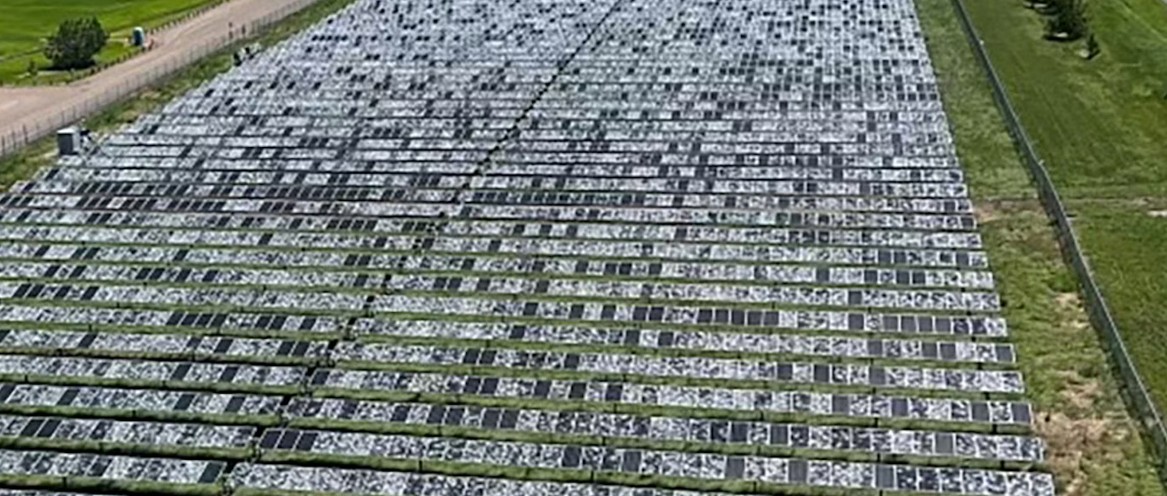
Source: https://cowboystatedaily.com/2023/06/27/baseball-sized-hail-smashing-into-panels-at-150-mph-destroys-scottsbluff-solar-farm/
Low power density and high land consumption
A central issue is the comparatively low power density of solar radiation.
Considering:
- daily and seasonal solar variation
- cloud cover and shading
- spacing between module rows
the average power density of ground-mounted PV is usually only about 5–20 W/m².
Intervention in the local energy balance
Ground-mounted PV changes energy distribution at ground level:
- less direct radiation reaching the soil
- altered surface heating
- changed evaporation conditions
- modified near-ground air movements
Part of the radiation energy is converted into electricity and removed from the local system. The remaining share is mainly converted into heat and re-radiated, altering the local radiation and heat balance.
Systemic considerations
Ground-mounted PV generates electricity only when the sun shines. This results in:
- strong daily fluctuations with seasonal variation
- low winter yield
- storage requirements and additional grid expansion causing very high costs
These factors reduce the actually usable share of generated energy.
Alternative: use of existing surfaces
Energetically, it is often more reasonable to use already sealed areas such as:
- roofs and façades
- parking areas and industrial sites
- noise barriers
This avoids additional land consumption.
Conclusion
Ground-mounted photovoltaics can contribute to energy supply but are associated with several major disadvantages:
- low energy yield per area and therefore high land demand
- interventions in landscape and land use
- changes to local energy balance with climatic effects
- strongly fluctuating electricity production
- high storage demand
- high risk of storm damage
From an energy perspective, prioritizing existing surfaces and using solar energy as directly as possible is often more reasonable than large-scale expansion of ground-mounted PV systems.
Further topics
👉 Back to startpage

 DE
DE  EN
EN