
 DE
DE  EN
EN 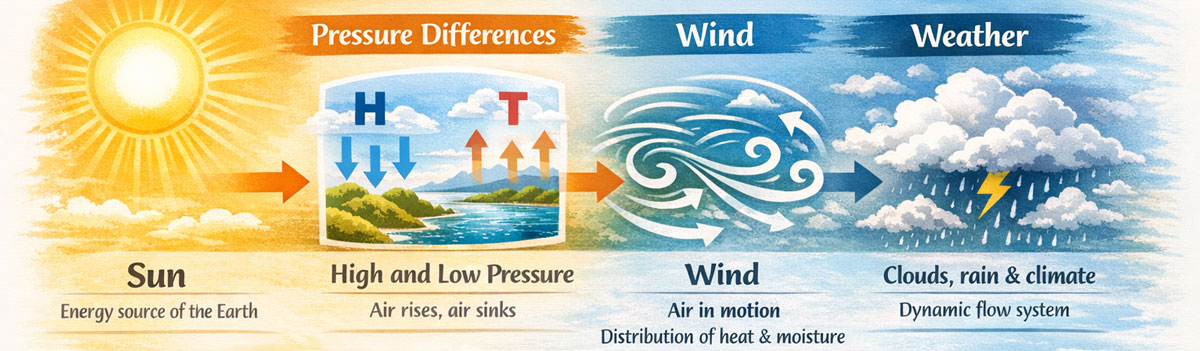
Wind and Weather – The Earth’s Underestimated Flow System
Wind is not merely a by-product of weather – it is its driving force. The Earth’s atmosphere functions like a global flow system in which energy, heat, and moisture are continuously in motion.
This system is driven exclusively by the sun. Its uneven radiation across differently absorbing surfaces, combined with the Earth’s rotation, creates significant temperature and pressure differences. These differences give rise to air currents and ultimately to wind.
In everyday life, we experience it as a gentle breeze or as a powerful storm. When wind speeds reach around 118 km/h (Beaufort scale force 12), it is classified as a hurricane-force wind. Tropical cyclones – such as hurricanes, typhoons, and cyclones – can become significantly stronger and unleash enormous destructive power.
More Than Moving Air
However, wind is far more than just moving air:
It transports vast amounts of energy and enormous quantities of water vapor from the oceans across and over the continents. Without these flows, there would be no functioning precipitation patterns, no balanced temperature distribution, and no stable climate system.
The Invisible Transport Mechanism
A large portion of the water that falls as rain over land originally comes from the oceans. It is transported through the atmospheric layers by the wind.
These so-called “flying rivers” are a central, often underestimated element of the climate system. They supply entire regions with moisture and play a decisive role in determining where rain falls – and where it does not.
Note
While all water from higher elevations ultimately flows back to the sea due to gravity, its replenishment through precipitation depends entirely on the wind.
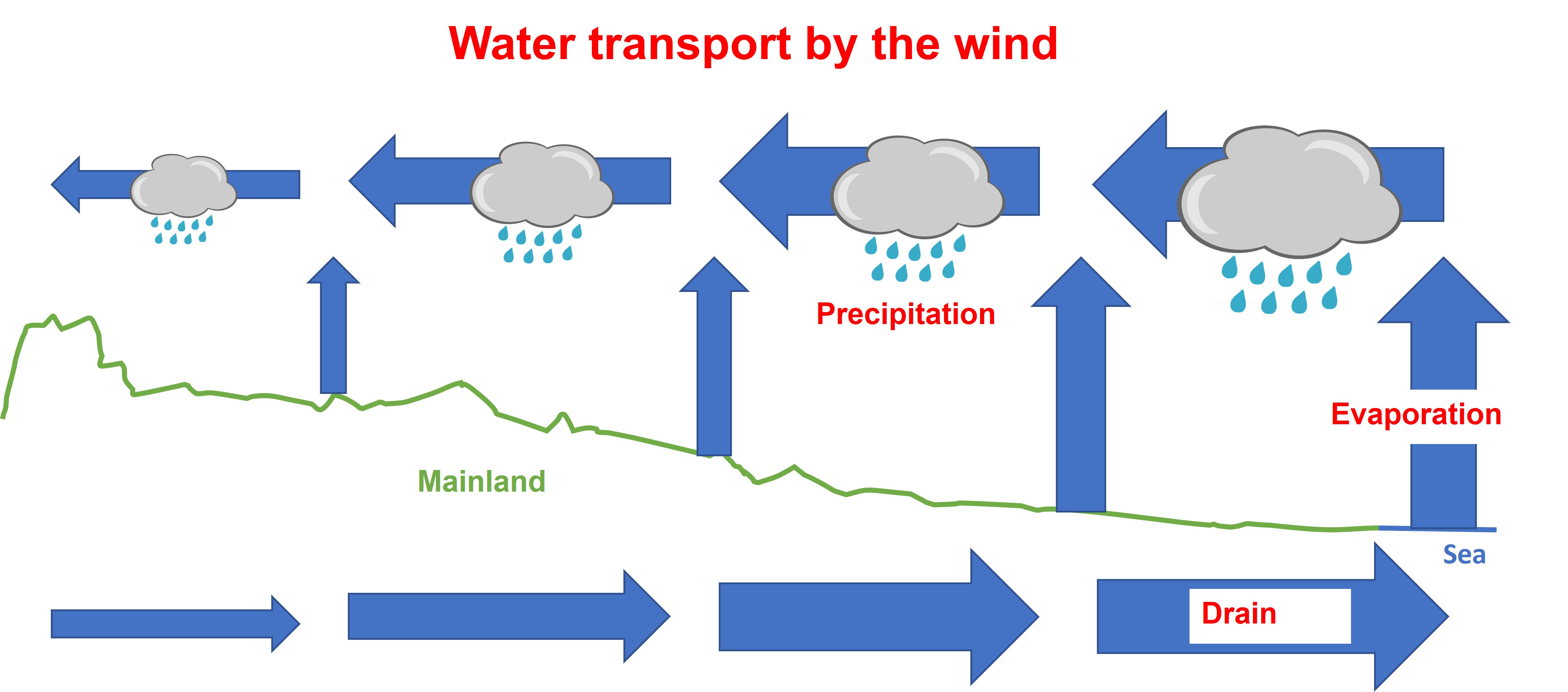
Water transport by the Wind
(© Brugger 2023)
A Sensitive Balance
The fundamental chain is simple:
Sun → Pressure differences → Wind → Transport of energy & moisture → Weather
Yet the system itself is highly sensitive.
It is based on finely tuned flow patterns that develop over large spatial and temporal scales.
In addition, the Earth’s rotation plays a crucial role. It is responsible for the Coriolis force, which deflects airflows and leads to the formation of three major circulation cells. These cells form largely closed climatic cycles that occur in both the Northern and Southern Hemispheres.
Major Climate Cells (see diagram):
- Polar Cells
- Ferrel Cells
- Hadley Cells
While the flows in the Polar Cells are driven by cold descending air and the Hadley Cells by rising air, the circulation in the Ferrel Cell is driven indirectly, or effectively “pulled along” by the adjacent cells.
High-speed jet streams circle the Earth near the tropopause, located between these circulation cells:
The polar jet streams flow between the Polar and Ferrel Cells, while the subtropical jets flow between the Ferrel and Hadley Cells. They act to balance pressure differences between the warm sunlit regions and the colder shaded regions.
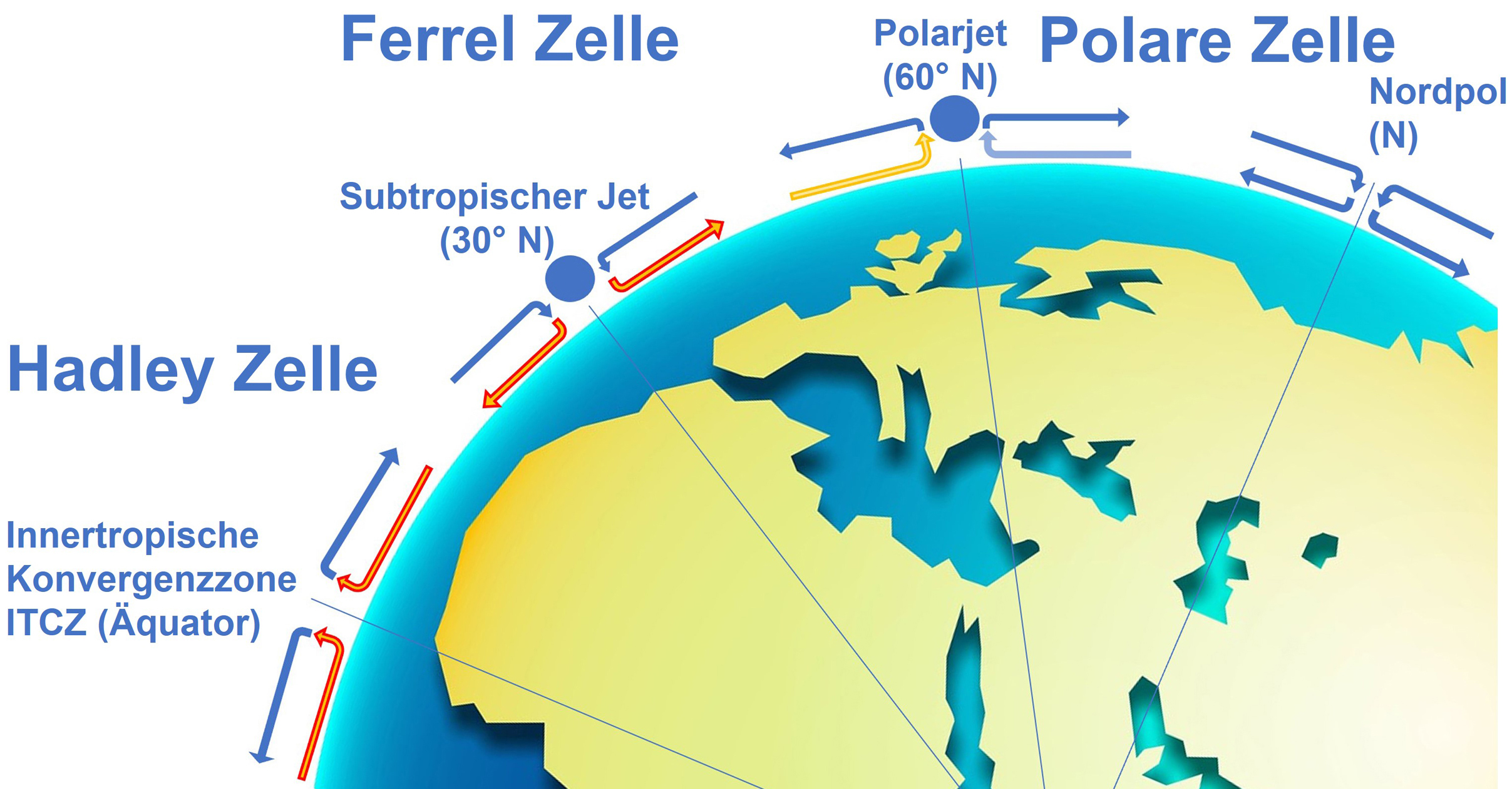
The formation of weather systems in the Northern Hemisphere
(© Brugger 2023)
Conclusion
Wind is a central component of the highly complex weather system. Together with water vapor, it plays a decisive role in shaping the climate and serves as the driving force of the global water cycle. It helps balance temperature differences and enables the exchange of gases between water and air. In doing so, it plays a vital role for both nature and humanity.
Anyone who intervenes in this system and extracts large amounts of energy from it is potentially interfering with the mechanisms of weather and climate.
The greatest extraction of energy occurs precisely in the weakest wind region – the Ferrel Cell – a particularly critical circumstance.
Further Reading
- Atmosphere
- Air pressure and temperature explained
- Global Water Circle
- Solar energy
- Wind energy
- The book about wind power and climate